 Skip-the-line available
 What to See at Ephesus
The essential monuments along the downhill walk, from Curetes Street to the Library of Celsus and the Great Theatre.
Ephesus is one of the best-preserved Greco-Roman cities in the Mediterranean, and its highlights line a single downhill walk from the Upper (South) Gate to the Lower (North) Gate. The unmissable monuments are the two-storey facade of the Library of Celsus, the vast Great Theatre with its estimated 25,000 seats, and the marble length of Curetes Street with the Temple of Hadrian along it. The separately ticketed Terrace Houses preserve painted rooms and mosaic floors from the city's wealthy quarter. Beyond the main site lie the Temple of Artemis, once one of the Seven Wonders of the Ancient World, and the Basilica of St John in nearby Selçuk. This guide walks the route in order and explains what each monument is and why it matters.
What is Curetes Street and the Temple of Hadrian?
Curetes Street is the great colonnaded avenue that forms the spine of a visit to Ephesus, running downhill from the Upper (South) Gate toward the Library of Celsus. Paved in marble and once lined with columns, statues, fountains and shopfronts, it was one of the main thoroughfares of the Roman city and still conveys the scale of daily life here. Walking down it you pass monuments, inscriptions and mosaic sidewalk fragments, building anticipation as the street descends toward the city's grandest facade. Along the way stands the Temple of Hadrian, a small but exquisitely carved second-century structure whose arched porch, ornamental reliefs and figure of Tyche make it one of the most photographed monuments on the site. Because the route runs downhill, Curetes Street is best walked from the top, letting gravity carry you gently toward the Library of Celsus while you take in the detail on either side.
The Temple of Hadrian is a highlight in miniature partway down Curetes Street, dedicated to the emperor Hadrian in the second century AD. Its curved arch is decorated with a relief of Tyche, the goddess of fortune, and its porch carries finely worked friezes that reward a close look. Set against the broader sweep of the avenue, it shows the craftsmanship the city lavished on even its smaller public buildings. Around it, Curetes Street preserves the fittings of an ancient street scene: bases that once held honorific statues, the remains of public fountains, and the famous latrines that illustrate Roman civic engineering. Take your time along this stretch, because it is where the texture of everyday Ephesus is richest. The street's gentle downhill gradient makes it an easy, rewarding walk, and it sets the stage for the Library of Celsus waiting at its foot.
Why is the Library of Celsus so famous?
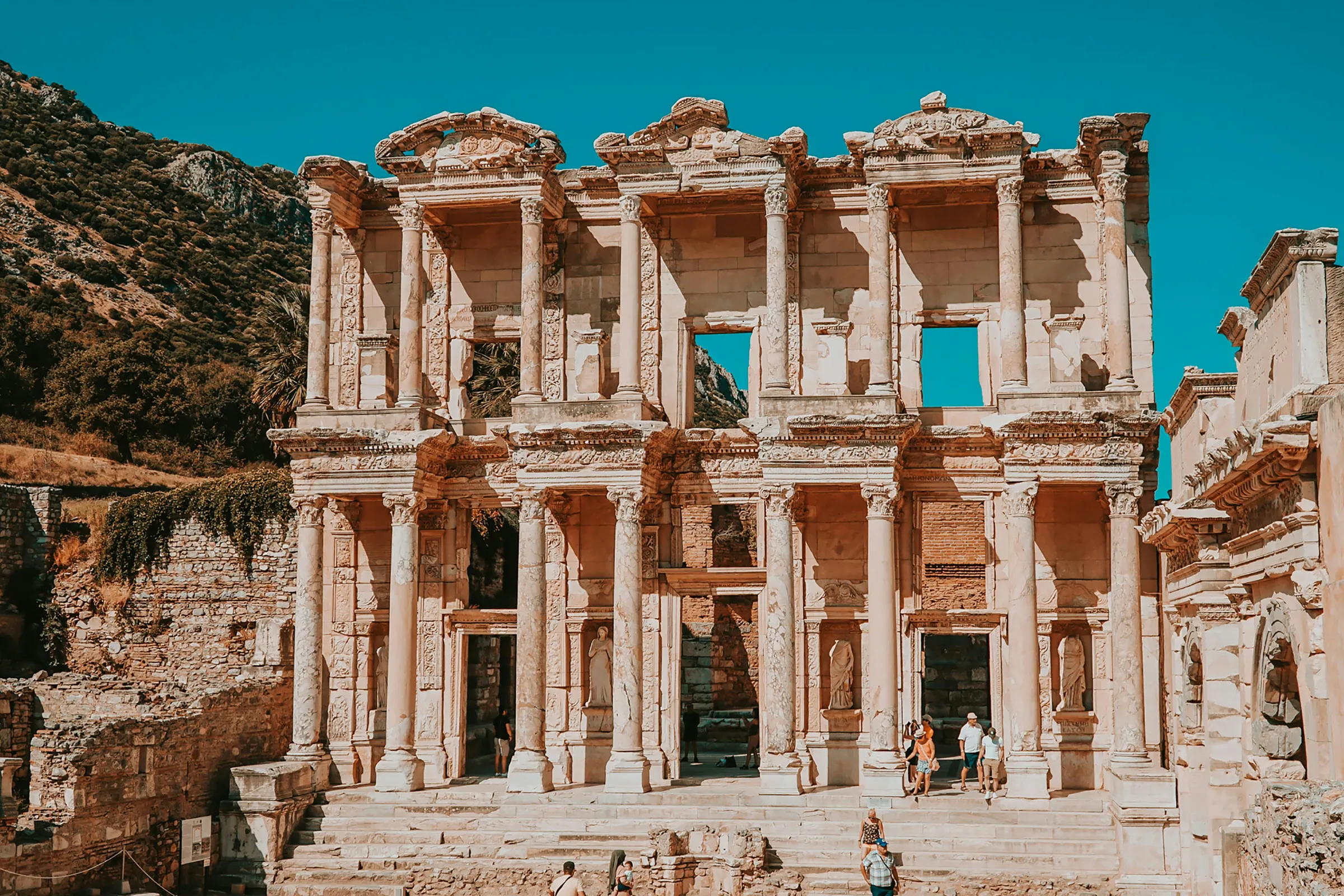
The Library of Celsus is the iconic image of Ephesus and one of the most striking monuments to survive from the Roman world. Built around 125 AD in memory of the Roman senator Tiberius Julius Celsus Polemaeanus, and completed by his son Gaius Julius Aquila, it once held nearly 12,000 scrolls, making it one of the great libraries of the ancient Mediterranean. Its reconstructed two-storey marble facade, with paired columns and statue niches representing virtues such as wisdom and knowledge, rises at the foot of Curetes Street to dramatic effect. Celsus himself was buried in a crypt beneath the building, an unusual honour for a private citizen. The facade you see today was carefully re-erected from original fragments in the twentieth century. Arriving early rewards you with the chance to photograph this masterpiece without crowds, before the midday cruise groups fill the small square in front of it.
Standing before the Library of Celsus, you are looking at both a monument to learning and a family tomb. The four statues set into the ground-floor niches personify the qualities of the man it honoured — wisdom, knowledge, judgement and virtue — while the elaborate columned facade was designed to appear even grander through clever adjustments to its proportions. In its day the reading rooms behind the facade stored their nearly 12,000 scrolls in wall niches protected from damp, a sophisticated piece of ancient architecture. The building sat at the heart of the city's civic and commercial life, beside the gate leading to the Commercial Agora. Because the facade faces east, morning light catches it beautifully, another reason to arrive early. The Library of Celsus is the natural climax of the downhill walk from the Upper Gate, and for many visitors it is the single reason to come to Ephesus.
What can I see at the Great Theatre and Harbour Street?
The Great Theatre of Ephesus is the largest monument on the site and one of the largest surviving theatres of the ancient world, with an estimated capacity of 25,000 spectators. Built into the western slope of Mount Pion, its tiered stone seating rises in a vast semicircle above the stage, offering sweeping views back over the ruins and along the former harbour road. The theatre is famous beyond its size: the Acts of the Apostles records a riot here, when the silversmith Demetrius stirred the crowd against the Apostle Paul over the trade in silver shrines of Artemis. Used for drama, public assembly and later gladiatorial contests, it remains a powerful space to stand in. Climbing partway up the seating gives the best perspective on the scale of the city. The Great Theatre sits near the Lower (North) Gate, making it a fitting finale to the downhill walk from the Upper Gate.
From the foot of the Great Theatre runs Harbour Street, the broad, once-colonnaded avenue that connected the city centre to its port. Also known as the Arcadian Way, it was one of the grandest streets of Ephesus, lined with columns and shops and reportedly lit at night, leading down to the harbour that made the city rich. Today the harbour is gone: the Küçükmenderes River silted it up over centuries, and the coastline retreated several kilometres, leaving Ephesus stranded inland and hastening its decline. Walking Harbour Street you can picture ships unloading where there are now fields. The street ends near the Lower Gate, so it forms the closing stretch of the classic route. Standing between the Great Theatre and Harbour Street, you grasp both the height of the city's prosperity and the reason for its eventual abandonment as trade moved elsewhere.
What are the Terrace Houses at Ephesus?
The Terrace Houses are the residential jewel of Ephesus, a cluster of luxurious homes built into the slope opposite the Temple of Hadrian on Curetes Street. Occupied by the city's wealthy citizens, they preserve remarkably intact mosaic floors, painted wall frescoes, marble panelling and even early domestic heating systems, offering an intimate contrast to the grand public monuments outside. They lie under a protective roof and are reached by a raised walkway that threads above the excavations, which also makes them a welcome shelter from the sun and rain. Because they require a separate ticket from the main site, some visitors skip them, but they reward the extra time with colour and detail found nowhere else in Ephesus. Our concierge recommendation is to build the Terrace Houses into the middle of your visit, both for their beauty and for the cool relief they provide during the hottest part of a summer day.
Inside the Terrace Houses you move through a series of connected dwellings that show how the Roman elite of Ephesus actually lived. The walls carry frescoes of mythological scenes and geometric designs, the floors are laid with fine mosaics, and rooms open onto small courtyards that once brought light and air into the homes. The covered walkway lets you look down into the excavated rooms while conservators continue their painstaking work, so the site feels like a living archaeological project. The enclosed, shaded environment makes the Terrace Houses far more comfortable than the open streets outside, especially at midday. Allow extra time here beyond the main-site route, as the detail rewards slow looking. Because entry is separately ticketed, decide before you arrive whether to include them; for most visitors the vivid interiors make the Terrace Houses one of the most memorable parts of a day at Ephesus.
What else should I see around Ephesus?
Beyond the main archaeological site, several monuments complete the story of Ephesus. On the edge of Selçuk lies the Temple of Artemis, once one of the Seven Wonders of the Ancient World; a colossal marble temple with over a hundred columns once stood here, though only a single reassembled column now marks the spot. Nearby rises the Basilica of St John, built in the sixth century under Emperor Justinian I over the traditional tomb of the apostle, its ruins commanding the hill of Ayasuluk in Selçuk. The Ephesus Museum in Selçuk holds many of the finest finds excavated from the city. Together these sites trace the arc from Ephesus as a pagan Greek and Roman metropolis to an early Christian centre. Our concierge recommendation is to pair the ruins with at least the Temple of Artemis and the Basilica of St John for a fuller picture of the city's long history.
The area around Ephesus is rich in religious as well as classical heritage. The House of the Virgin Mary, on Bülbül Mountain about 7 kilometres from Selçuk, is venerated as a place where Mary is believed to have spent her final years, and it draws pilgrims and visitors of many faiths to a small stone chapel in a quiet wooded setting. Combined with the Basilica of St John and the last column of the great Temple of Artemis, it shows how sacred traditions layered onto the ancient city over the centuries. These sites are spread across Selçuk and the surrounding hills, so a car or transfer makes it practical to link them with the main ruins in a single trip. For visitors interested in the full sweep of Ephesus, from Ionian foundation to Christian pilgrimage, they are well worth the extra journey.
Frequently asked
What are the must-see highlights at Ephesus?
The essential sights are the Library of Celsus, the 25,000-seat Great Theatre, the marble Curetes Street with the Temple of Hadrian, and the separately ticketed Terrace Houses. Beyond the main site, the Temple of Artemis and the Basilica of St John in Selçuk complete the visit.
Why is the Library of Celsus famous?
The Library of Celsus is famous for its dramatic two-storey marble facade and its history: built around 125 AD in memory of the senator Tiberius Julius Celsus Polemaeanus, it once held nearly 12,000 scrolls and served as his tomb, an unusual honour for a private citizen.
How big is the Great Theatre at Ephesus?
The Great Theatre had an estimated capacity of about 25,000 spectators, making it one of the largest surviving theatres of the ancient world. Built into the slope of Mount Pion, it is also known from the Acts of the Apostles as the scene of a riot against the Apostle Paul.
What is Curetes Street?
Curetes Street is the main colonnaded marble avenue of Ephesus, running downhill from the Upper Gate to the Library of Celsus. It was lined with columns, statues, fountains and shops, and along it stands the finely carved second-century Temple of Hadrian.
Are the Terrace Houses worth visiting?
Yes. The Terrace Houses preserve intact mosaics, frescoes and marble panelling from the homes of wealthy Ephesians, offering detail found nowhere else on the site. They require a separate ticket and lie under a protective roof, which also makes them a cool refuge from the midday sun.
Can I still see the Temple of Artemis?
Only one reassembled column now stands at the site of the Temple of Artemis on the edge of Selçuk, where a vast marble temple with over a hundred columns once ranked among the Seven Wonders of the Ancient World. It is a short stop worth pairing with the ruins.
What is the Basilica of St John?
The Basilica of St John was built in the sixth century under Emperor Justinian I over the traditional tomb of the apostle John, on the hill of Ayasuluk in Selçuk. Its extensive ruins are a highlight of the area and pair naturally with a visit to Ephesus.
How much of Ephesus can I see in one visit?
The main downhill route from the Upper Gate to the Lower Gate covers Curetes Street, the Library of Celsus, the Great Theatre and Harbour Street in two to three hours. Adding the Terrace Houses, the Temple of Artemis and the Basilica of St John can extend the visit to half a day.
What order should I see the monuments in?
Follow the downhill route from the Upper (South) Gate: Curetes Street and the Temple of Hadrian first, then the Library of Celsus, then the Great Theatre and Harbour Street toward the Lower Gate. Fit the Terrace Houses in the middle, both for their beauty and for shade.